Iran’s top security official in Oman following nuclear talks with US
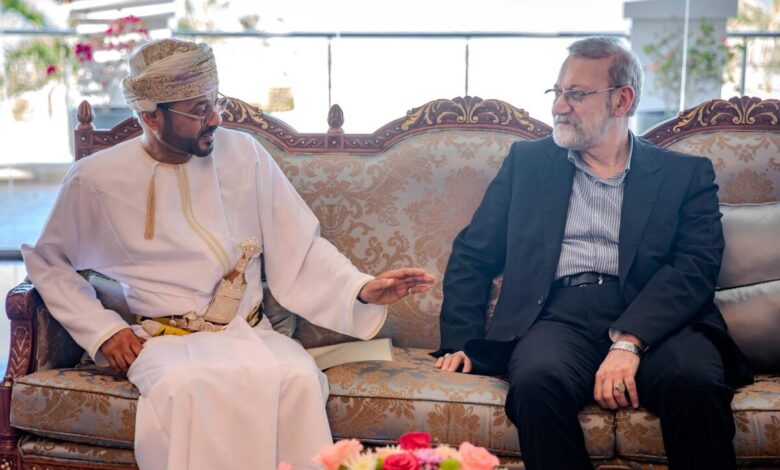

Ali Larijani, a top security official in Iran’s government, met Oman’s ruler Sultan Haitham bin Tariq Al Said to seek a way forward following nuclear talks held in the country between Tehran and Washington.
The two “discussed the latest developments in the Iranian-American negotiations”, the official Oman News Agency reported on Tuesday.
They also explored “ways to reach a balanced and just agreement between the two sides, and emphasised the importance of returning to the table of dialogue and negotiation”, it added.
Larijani, a close adviser to Iran’s Supreme Leader Ayatollah Ali Khamenei, was also due to meet Omani Foreign Minister Badr al-Busaidi, the chief intermediary in the US-Iran talks.
Iran’s state-run IRNA news agency said “discussions over the latest regional and international developments” were on the agenda for Larijani’s visit to Muscat.
Oman hosted talks on Iran’s nuclear programme last week aimed at avoiding a major conflict between Tehran and Washington, amid surging tensions and a growing US military build-up in the region.
It was an outcome of concerted diplomatic efforts in the region to avert conflict. A second round of talks has been confirmed but a date hasn’t been announced.
IRNA reported Iranian Foreign Minister Abbas Araghchi held a series of phone calls with his counterparts in Turkiye, Egypt, and Saudi Arabia to brief them on the latest developments in the negotiations with Washington in Muscat.

‘Poison the well’
Abas Aslani, from the Center for Middle East Strategic Studies, noted Larijani’s meeting with the intermediary Sultan Haitham was a lengthy one, which could bode well even though there’s been a “battle of narratives” between Iran and the US.
“At the lexicon of high-stakes diplomacy, duration is very significant and important if not promising. So it seems both sides, including Iran, they need to have a better and clearer understanding of the situation before they reconvene for the potential second round [of negotiations] with the United States,” Aslani said.
Israel Prime Minister Benjamin Netanyahu’s trip to Washington, DC, is likely an attempt “to poison the well before this diplomatic process gains traction”, he told Al Jazeera.
“It seems Netanyahu will tactically try to disrupt the process, and he wants to push the United States to include the missiles issue in the negotiations because it is a source of worry for Israel.”
Tehran condemns Israeli influence
At a news briefing on Tuesday, Esmaeil Baghaei, spokesperson for Iran’s Ministry of Foreign Affairs, said Larijani’s visit was part of regional consultations in line with Tehran’s policy of strengthening relations with neighbouring countries, and had been planned in advance.
Regarding the negotiations with the United States, Baghaei said Washington “must act independently, free from the destructive pressures being exerted that harm the region and American interests”.
He urged the US to resist Israeli pressure over the nuclear issue, saying “one of the United States’ problems in the region is its subservience to the demands of the Zionist entity, which is the primary factor destabilising security in the region”.
Baghaei said after the collapse of the diplomatic process last year, it was “unrealistic to expect detailed discussions in the very first meeting”.
“The Muscat meeting itself was brief, lasting about half a day, and from our perspective was mainly aimed at assessing the other side’s seriousness and exploring how the process might proceed,” he said.
The focus, he added, has been on general principles and Iran’s “core positions” are clear – “securing the Iranian people’s interests based on international law and the Nuclear Non-Proliferation Treaty, including the right to peaceful use of nuclear energy”.
Larijani will visit Qatar after his trip to Oman, said Baghaei.
Iran hints at uranium dilution
Both sides have given mixed signals about their progress in the negotiations.
However, on Monday, Iran’s atomic energy chief Mohammad Eslami said Tehran is open to diluting its highly enriched uranium if the US ends sanctions, signalling flexibility on a key American demand.
Eslami said the prospects of Iran diluting its 60 percent enriched uranium, a threshold close to weapons-grade, would hinge on “whether all sanctions would be lifted in return”, IRNA reported.
US President Donald Trump has repeatedly called for Iran to be subject to a total ban on enrichment, a condition Tehran has dubbed unacceptable.
Washington has also demanded Iran relinquish its stockpile – estimated last year by the United Nations nuclear agency at more than 440kg (970lb) – of uranium enriched to up to 60 percent fissile purity, a small step away from the 90 percent that is considered weapons-grade.
Araghchi, speaking to diplomats at a summit in Tehran on Sunday, signalled Iran would stick to its position that it must be allowed to enrich uranium.
“The Americans are now saying that they are looking for a package of comprehensive negotiations to include other controversial issues such as the ballistic missiles, defence capabilities, regional activities of the country,” said Al Jazeera’s Tohid Asadi, reporting from Tehran.
“Meanwhile, Tehran is saying it wants talks to be focused and concentrated around the nuclear policy, and for the knots to be untangled one by one.”
Further talks expected
The date of the next round of talks has yet to be announced, although Trump has said they will be held this week.
Iran and the US held five rounds of talks last year on curbing Tehran’s nuclear programme, with the process stalling largely owing to disputes over uranium enrichment.
Washington then joined Israeli strikes on Iran last June, targeting the Natanz, Fordow and Isfahan nuclear facilities with bunker-buster bombs.
Since those strikes, Tehran has said it halted enrichment activity. It has always maintained that its nuclear programme is solely for peaceful purposes.
Larijani’s Oman trip comes as Netanyahu left for the United States for a meeting with Trump to discuss Washington’s ongoing negotiations with Iran. The planned meeting will be the seventh between Trump and Netanyahu since the US president returned to office last year.
Reporting from the White House, Al Jazeera’s Kimberly Halkett said Netanyahu will likely push to appear “forceful and strong” to his domestic base in Israel in lobbying for a hardline approach to Iran in Washington, DC.
“He’ll be talking about making sure that Israel’s demands remain intact,” Halkett said. “But again, this has a lot to do with the fact that he wants to be seen doing it versus just picking up the telephone.”
The US has sought to include Iran’s ballistic missile arsenal in negotiations, but Tehran has ruled this out, with Araghchi insisting its missile programme is “non-negotiable”.