import_all_aljz.xml
Trump threatens charges for George Soros, frequent target of far-right ire

United States President Donald Trump has advocated for George Soros, a billionaire financier and philanthropist who has become a central figure in right-wing conspiracies, to face criminal charges.
In a social media post on Tuesday, Trump said that Soros and his son Alex should be indicted for supporting violent riots in the US, a baseless claim that the president has pushed before.
Trump recommended that they be charged under the Racketeer Influenced and Corrupt Organizations (RICO) Act, a federal law often used against organised crime.
“George Soros, and his wonderful Radical Left son, should be charged with RICO because of their support of Violent Protests, and much more, all throughout the United States of America,” Trump wrote in the post.
“Soros, and his group of psychopaths, have caused great damage to our Country! That includes his Crazy, West Coast friends. Be careful, we’re watching you!”
Various right-wing figures, including Hungarian Prime Minister Viktor Orban and Indian Prime Minister Narendra Modi, have embraced conspiracy theories that the Soros family secretly funded riots and politically destabilising activity in their countries.
Trump himself has cited that belief to explain public protests he encountered, including during his first term.
After he nominated Brett Kavanaugh to the Supreme Court in 2018, for example, Trump alleged on social media that the protests against the future justice were funded by Soros.
“The very rude elevator screamers are paid professionals only looking to make Senators look bad,” Trump wrote at the time. “Also, look at all of the professionally made identical signs. Paid for by Soros and others. These are not signs made in the basement from love!”
A Jewish Holocaust survivor, Soros has also featured prominently in anti-Semitic conspiracy theories on the far right.
He is the founder of the Open Society Foundations, which supports civil society groups around the world and promotes democratic governance, public health, criminal justice and education.
The Wall Street Journal reported in June 2023 that Alex Soros had been placed in charge of the foundation by his elderly father, now 95 years old.
While no charges appear to have been filed against Soros thus far, the post comes as Trump steps up threats and probes into political rivals and pushes a maximalist view of his powers as president.
A spokesperson for the Open Society Foundation, meanwhile, responded to Trump’s comments with a statement to the news agency Reuters.
“These accusations are outrageous and false. The Open Society Foundations do not support or fund Violent Protests,” the spokesperson said. “Our mission is to advance human rights, justice, and democratic principles at home and around the world.”
US shooting at Minneapolis school kills two people, injures 20

A shooting at a school in Minneapolis, Minnesota, has killed two people and injured about 20, a United States Department of Justice official says. The shooter is also dead, the official says.
Minneapolis police said earlier that they responded to a shooting at a Catholic church and school in the south end of the city on Wednesday, and authorities added that the shooter had been “contained”.
“I’ve been briefed on a shooting at Annunciation Catholic School and will continue to provide updates as we get more information,” Governor Tim Walz wrote on X.
The shooting comes after a wave of false reports of active shooters at college campuses around the US as students return from summer break.
“I’m praying for our kids and teachers whose first week of school was marred by this horrific act of violence,” Walz said without providing details on potential victims.
The municipal government confirmed the shooting on X.
“There is no active threat to the community at this time. The shooter is contained,” the City of Minneapolis said.
“The families of children at the school can go to the reunification zone at the Annunciation School,” the city said in a second post on X.
A spokesperson for Hennepin Healthcare, which operates Minnesota’s largest emergency department, stated in a text message that the organisation was responding to an emergency and provided no details. A social media post from the company said it was caring for patients from the shooting.
US President Donald Trump said he had been briefed on the shooting, describing it as a “terrible situation”.
“I have been fully briefed on the tragic shooting in Minneapolis, Minnesota,” Trump said on his Truth Social network.
“The FBI quickly responded, and they are on the scene. The White House will continue to monitor this terrible situation. Please join me in praying for everyone involved!”
Why ICJ Judge Sebutinde faces calls to quit from Israel genocide case
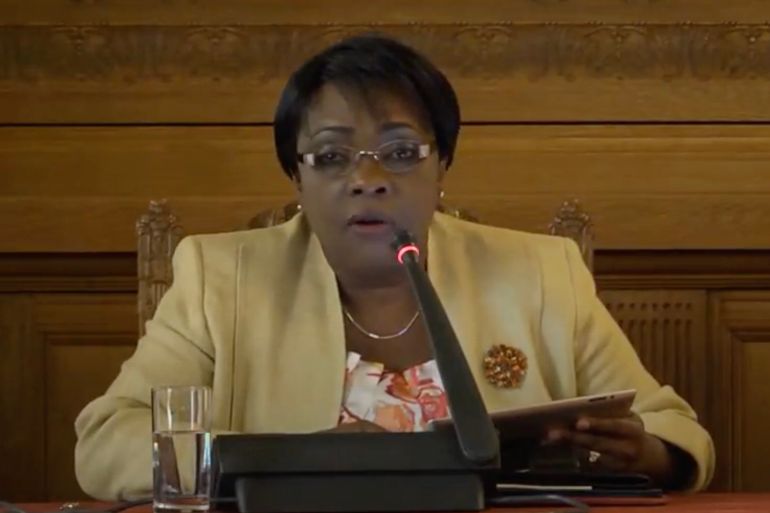
The International Commission of Jurists has filed a formal request for an investigation into International Court of Justice (ICJ) Vice President Julia Sebutinde over her recent comments about Israel.
The commission, which advocates for human rights and rule of law worldwide, argued that Sebutinde’s position on Israel reveals a bias that brings judicial integrity into question. Sebutinde, who is one of the 17 judges in the ICJ genocide case against Israel, also faces other critics.
Here is more about Sebutinde, what she said and why she is facing criticism:
Who is Julia Sebutinde?
Sebutinde is one of the judges hearing South Africa’s genocide case against Israel. These are the same judges who voted on provisional measures to protect Palestinians in Gaza in January 2024.
Sebutinde, 71, is a Ugandan judge who is currently serving her second term at the ICJ, where she has sat since March 2012. She is the first African woman appointed to the The Hague-based ICJ. She was elected as the vice president of the top United Nations court in February 2024.
According to the Institute for African Women in Law, Sebutinde was raised by a family of modest means during Uganda’s independence movement. She attended Lake Victoria Primary School in Entebbe, Uganda, and Gayaza High School, a girls boarding school. She earned her law degree from Makerere University in 1977.
In 1990, Sebutinde obtained a master of laws degree with distinction from the University of Edinburgh in Scotland, which also awarded her an honorary doctorate in 2009 for her legal achievements.
Before joining the ICJ, she served as a judge on the Special Court for Sierra Leone beginning in 2007.
What was Sebutinde’s dissenting opinion on Palestine?
In a case filed in December 2023, South Africa alleged that Israel was committing genocide in Gaza during the war that began on October 7, 2023. South Africa argued that Israel’s actions in Palestine were genocidal because they intended to “bring about the destruction of a substantial part of the Palestinian national, racial and ethnical group”.
On January 26, 2024, the ICJ issued a ruling on a number of interim steps. It ordered six provisional measures, telling Israel to:
- Take action to prevent acts of genocide
- Prevent incitement to commit genocide
- Let more humanitarian aid into Gaza
- Protect and keep evidence related to accusations of genocide under the Genocide Convention.
- Allow fact-finding missions
- Report to the court on measures taken
Fifteen of the 17 judges voted for all the emergency measures to be put in place. An Israeli judge voted for two of the six measures to be implemented. Sebutinde was the only judge to vote against all the measures.
In her dissenting opinion, Sebutinde wrote: “In my respectful dissenting opinion the dispute between the State of Israel and the people of Palestine is essentially and historically a political one. It is not a legal dispute susceptible to judicial settlement by the Court.”
She also stated that South Africa did not demonstrate that Israel’s alleged actions were “committed with the necessary genocidal intent, and that as a result, they are capable of falling within the scope of the Genocide Convention”.
The court’s final verdict is still awaited. Last year, the International Criminal Court issued arrest warrants for Israeli Prime Minister Benjamin Netanyahu and former Defence Minister Yoav Gallant for war crimes.
Several rights organisations have called Israeli actions in Gaza genocide. Israel has also been accused of war crimes and crimes against humanity during nearly 23 months of war, which have killed more than 62,000 Palestinians.
Who has called for Sebutinde to be investigated and why?
The Geneva-based International Commission of Jurists, made up of 60 judges and lawyers, wrote a letter on Friday to ICJ President Yuji Iwasawa requesting the investigation. It cited remarks Sebutinde made on August 10 at Watoto Church in Kampala, Uganda, where she said: “The Lord is counting on me to stand on the side of Israel.”
The letter added that Principle 2 of the UN Basic Principles on the Independence of the Judiciary affirms that “the judiciary shall decide matters before them impartially, on the basis of facts and in accordance with the law, without any … improper influences … from any quarter and for any reason.”
Sebutinde’s remarks are “inconsistent with these principles”, said the letter, signed by the commission’s secretary-general, Santiago Canton.
Canton closed the letter by urging Iwasawa to conduct an investigation into the allegations against Sebutinde and take remedial actions if the allegations are found to be true.
While an investigation takes place, Canton requested Iwasawa remove Sebutinde from further proceedings in the ICJ case filed by South Africa.
The government of Uganda distanced itself from her dissenting opinion.
“Justice Sebutinde’s ruling at the International Court of Justice does not represent the Government of Uganda’s position on the situation in Palestine,” Adonia Ayebare, Uganda’s ambassador to the UN, posted on X in January last year.
Could Sebutinde be removed? How?
The ICJ statute says members of the ICJ cannot be dismissed unless other members unanimously agree that they no longer fulfil the required conditions.
If a judge is dismissed, the ICJ registrar makes a formal notification to the UN secretary-general and this notification renders the position vacant.
The ICJ website adds that this has never happened.
The website sets standards for its judges, stating: “Judges must be elected from among persons of high moral character, who possess the qualifications required in their respective countries for appointment to the highest judicial offices, or are jurisconsults of recognised competence in international law.”
It also adds that “once elected, a Member of the Court is a delegate neither of the government of his own country nor of that of any other State.”
The ICJ statute adds that before assuming duties at the ICJ, members must make a solemn declaration that they will exercise their powers impartially and conscientiously.
Who are the judges in the case?
The ICJ has 15 judges elected for nine-year terms by the UN General Assembly and the Security Council.
For the case that South Africa brought against Israel, an Israeli judge and a South African judge joined the bench. From South Africa, senior retired Judge Dikgang Moseneke came on board while former Israeli Supreme Court Chief Justice Aharon Barak joined the case from Israel.

Macron hits back at Netanyahu over claims of fuelling anti-Semitism

President Emmanuel Macron has rebuked Israeli Prime Minister Benjamin Netanyahu for accusing him of fuelling anti-Semitism, calling the comments an “offence to France as a whole”.
The French leader responded to his Israeli counterpart in a letter published on Tuesday in several newspapers, in which he said Netanyahu’s recent accusations aimed at Macron were “unacceptable” and warned that the battle against anti-Semitism “must not be weaponised”.
“Accusations of inaction in the face of a scourge that we are fighting with everything in our power are unacceptable and are an offence to France as a whole,” Macron wrote in the letter.
“The fight against antisemitism must not be weaponised and will not fuel any discord between Israel and France.”
The French leader also appealed to Netanyahu to bring the “murderous and illegal permanent war” in Gaza to an end, saying it was “causing indignity for your country and placing your people in a deadlock”.
France and Israel have been embroiled in a diplomatic spat since last week, when Netanyahu accused Macron of fuelling “the anti-Semitic fire” in France by planning to recognise Palestinian statehood.
The accusation was contained in a letter which claimed that anti-Semitism had surged in France since Macron’s recent announcement that he would recognise Palestine as a state at a meeting of the United Nations General Assembly next month.
The French president’s office responded by labelling the remarks “abject” and “erroneous”.
“This is a time for seriousness and responsibility, not for conflation and manipulation,” the French presidency said last week, adding that violence against the Jewish community was “intolerable” and asserting that France “protects and will always protect its Jewish citizens”.
The row has widened to draw in Israel’s chief ally, the United States, after Washington’s ambassador to France, Charles Kushner, published an open letter to Macron in The Wall Street Journal on Sunday, echoing the allegation that France was failing to take sufficient action against anti-Semitism.
Kushner, the father of Trump’s son-in-law, was summoned to the French Ministry for Europe and Foreign Affairs over the accusations, which France said were “unacceptable”, but the US embassy’s charge d’affaires went in his place, as Kushner was absent.
Dozens injured as Israeli forces raid Nablus in occupied West Bank

Dozens of people have been injured in an Israeli military raid on the Palestinian city of Nablus in the northern occupied West Bank, according to medical sources.
At least 80 people were wounded, including several who were hit with live ammunition, during the raid that began early on Wednesday, medical sources told Al Jazeera.
The Palestine Red Crescent Society told Al Jazeera that its teams treated 36 people, including some who suffered tear gas inhalation.
The raid began about 3am (00:00 GMT), residents said, with soldiers storming several neighbourhoods of the Old City of Nablus, which has a population of 30,000 people.
Israel’s military deployed snipers and military vehicles, the Palestinian news agency Wafa reported.
Footage from the town, verified by Al Jazeera’s fact-checking agency Sanad, showed Israeli forces firing tear gas canisters to disperse the protesters while other videos documented young people throwing stones at military vehicles and soldiers during chase-and-run operations, which included the arrest of a child.
Soldiers were “storming and searching houses and shops inside the Old City while some houses have been turned into military posts”, said Ghassan Hamdan, head of the Palestinian Medical Relief organisation in Nablus.
Reporting from Doha, Qatar, Al Jazeera’s Willem Marx said hundreds of soldiers were involved in the raid.
“The governor of Nablus, Ghassan Dhaglas, told me he thinks as many as 2,000 Israeli soldiers have been involved in this operation. He described it as a show of force ‘with no justification’.”
“There have been some arrests,” he said.
“The Israeli military is not sharing details about the operation. They say they will release details once it is finished,” he added.
The West Bank has seen a surge in Israeli military and settler violence since Israel launched its war on Gaza in October 2023, and tens of thousands of Palestinians have been forced out of their homes.
At least 982 Palestinians, including hundreds of children, have been killed by Israeli forces and settlers across the territory since October 2023, according to the Office of the United Nations High Commissioner for Human Rights.
The Old City of Nablus has been the focus of several major Israeli raids. In early June, the Israeli army carried out an operation there in which at least two Palestinians were killed.
On Tuesday, the Israeli army launched a prolonged raid on Ramallah and el-Bireh, also in the West Bank, with the Palestine Red Crescent Society reporting that at least 58 Palestinians were wounded, including at least one child.
Israeli security forces seized about 1.5 million shekels ($447,000) from money exchange centres during the raid, Israeli police said.
Taiwan’s northeast rattled by magnitude 6 offshore earthquake

A magnitude 6 earthquake has struck off the northeast coast of Taiwan, shaking buildings in the capital, Taipei.
The quake’s epicentre was about 20km (12 miles) offshore from Yilan county at a depth of 112km (70 miles), officials said.
Authorities said monitoring was continuing, with Taiwan’s fire department adding that it had received no reports of damage.
Taiwan lies on the boundary of two tectonic plates and is frequently hit by earthquakes.
In April 2024, a magnitude 7.4 quake in Hualien killed at least 19 people and damaged hundreds of buildings. The earthquake was the strongest in 25 years.
More than 100 people were killed in a southern Taiwan quake in 2016.
The deadliest seismological event in recent decades occurred on September 21, 1999, when the so-called “921 earthquake”, named for the month and day it occurred, near the town of Jiji left more than 2,400 people dead .
A pyrrhic victory? An Ecuadorian town grapples with a divisive mine closure
A pyrrhic victory? Ecuador grapples with a divisive mine closure
Activists in Rio Blanco, Ecuador, expelled a mine company from their community. But the move sparked tensions and violence between neighbours.


Rio Blanco, Ecuador – Today, the Rio Blanco mining camp in south-central Ecuador lies in ruins.
Shattered china litters the ground not far from a hollowed-out kitchen with no walls left standing. An abandoned mine tunnel — as wide as a house — stands on a hillside, overlooking the charred remains of a diesel station.
In 2018, environmentalists hailed Rio Blanco’s closure as a landmark win for conservation. A court had sided with local activists and ordered the gold-and-silver mine to suspend its operations.
But nearly seven years later, the adjacent settlement, also called Rio Blanco, struggles to contend with the mine’s legacy and the divisions its closure has sown among residents.
Eloy Alfaro, an expert in mining conflicts and reconciliation, first visited Rio Blanco in 2018 as a professor at the University of Cuenca. He saw firsthand the aftermath of the mine’s departure.
“The community was broken, fractured,” Alfaro told Al Jazeera. “Since then, there have been murders. There have been suicides. They have been completely torn apart.”
Now, with recently re-elected President Daniel Noboa seeking to expand mining in Ecuador, critics are looking to sites like Rio Blanco to understand the risks — and what life might look like after the extraction process ends.
A divided community


The isolated hamlet of Rio Blanco sits in the grassy, stone-studded foothills of the Andean mountain range, mere kilometres outside Ecuador’s Cajas National Park.
About 80 families live in the village, many of them farmers who identify as Indigenous.
Income insecurity and unemployment in the region are high. While Ecuador overall has a poverty rate of 28 percent, the number spikes to more than 43 percent in rural areas like Rio Blanco.
Extreme poverty, meanwhile, is tallied at 27 percent in Ecuador’s countryside as of December 2024. That dwarfs the rate in urban areas, which sits at just 6 percent.

Jhon, a community member who asked not to use his real name for fear of reprisals, said that the mine’s closure has led to disagreements about the local economy.
Some believe the mine needed to be shuttered to protect the alpine water resources from toxic run-off and other environmental harms.
Others, however, have seen their livelihoods disappear with the rumble of the mining trucks.
“They say, ‘I don’t have a job because of you. You took away my ability to feed my family,’” Jhon said.
These tensions have bubbled into deadly disputes, according to Jhon and others in the community.
In March 2021, for example, Andrés Durazno — a Rio Blanco environmental leader known as the “guardian of the hill” for his activism — was stabbed and killed outside his home.
Community members told Al Jazeera that he was killed by a pro-mining family member who then fled justice.
“Can you imagine? Your cousin or your sister becomes your mortal enemy,” Alfaro said.
Broken promises


Initially, the mining project won the support of the majority of locals.
In 1999, the Canadian International Minerals Corporation (IMC) secured the rights to mine Rio Blanco and promised the community new social projects and high-paying jobs.
“They told us that, as long as the mine was operating, we’d live well [and] would have everything because they would help us,” said Jhon, who worked for the mine before advocating for its eventual closure.
Yaku Pérez, a lawyer who later represented the community in court, estimated that 90 percent of Rio Blanco’s residents backed the project at first.
Many even went into debt to buy pick-up trucks on the understanding that they would be driving for the mine, he said.
“They bought the vehicles, and when the time came, [the company] didn’t give them work,” Pérez said.
Jhon also felt a sense of betrayal. “In the end, they did nothing of substance to support us, and destroyed everything. It was like taking candy from a baby.”
The IMC could not be reached for comment, as the corporation has ceased to exist. Requests for comment from the companies involved in its acquisition were not returned by the time of publication.
In 2013, the Chinese-owned consortium Ecuagoldmining took over the Rio Blanco project.
Just as with the previous owner, locals accused Ecuagoldmining of doing little to help the community.
For instance, company representatives planted non-native pines near the mine. “They told us that we could use the wood to build houses,” Jhon explained.
To this day, the trees form unnaturally straight rows that mark the mine from afar. But Jhon and other community members said these invasive species have instead displaced native plants.
Environmental concerns


Community members also accused the mine of leaching arsenic into the water supply used for drinking and agriculture.
In 2016, the year the company started construction on the mine, an independent report warned of the risk to local waterways.
It found that Ecuagoldmining’s environmental studies appeared to have “underestimated” the impact of the Rio Blanco mine, including its projected arsenic discharge.
“The extremely high arsenic content in the rock in the area will very likely be released, posing an enormous risk to the health of the communities and dairy cattle downstream,” Jennifer Moore, a coordinator for the advocacy group MiningWatch Canada, wrote in an introduction to the report.
Community members in the years since have blamed the mine’s operations for drying up the highland wetlands and making cattle-ranching untenable.
“The mine took everything,” Eli Durazno, a local civil society leader, told Al Jazeera. “We lost our animals. We lost our streams, our wetlands, our very landscape.”
Today, tonnes of drill core samples extracted during Ecuagoldmining’s exploration spill from the wreckage of the camp.
“If those samples contain sulfur, they may oxidise into sulfuric acid and, upon contact with rain, release the metals they contain [into the soil],” Sandra Barros, a local hydrology engineer, told Al Jazeera.
Ecuagoldmining did not respond to Al Jazeera’s requests for comment.
On social media, however, the company said it was committed to “sustainable mining” at Rio Blanco in a way that was “responsible for society and the environment”.
It pointed to reports that it says show “no contamination of the area where the Rio Blanco Mining Project is located”.
The company also touted its efforts to improve local infrastructure, including schools. “We foster productivity that drives community development,” it said in one post.
A legal fight


As concerns about the environmental damage mounted, Ecuagoldmining’s presence split the community. Some began to look for a way to kick the multinational out.
“The locals began to realise that the mine wasn’t going to comply with any of its promises,” said Pérez. “First, they started to doubt, then mistrust, and finally, they turned on the project.”
A councilman from the nearby city of Cuenca filed a complaint to suspend it, arguing that the company violated the community’s right to informed consent, threatened the region’s water supply and failed to produce adequate impact studies. A local judge denied the petition.
But resistance was growing. The community started a pilot eco-tourism project to offer an alternative income source to mining. A few months later, however, Ecuagoldmining erected fences that blocked the local hiking trails.
Ecuagoldmining had no legal claim to the fenced land, according to Alfaro, the expert in mining conflicts.
“It was communal territory. It could not be sold,” Alfaro told Al Jazeera.
In 2018, the human rights nonprofit FIAN Ecuador released a report alleging that both the IMC and Ecuagoldmining acquired communal lands through false claims and by pressuring families to sell property they never legally held.
For its part, Ecuagoldmining has maintained it acted within the law.
It also questioned whether locals qualified for prior consultation on construction projects, a right reserved for Indigenous people under Ecuador’s constitution.
“The #RioBlanco project has complied with legislation. DON’T BE DECEIVED!” the company wrote on its Facebook page.
But community members say that the “privatisation” of communal land not only sowed strife but also disrupted their daily life as farmers.
“The community could no longer reach their pastures,” Alfaro explained. “In six months, they went hungry.”
He credits female activists with starting to push back: “That’s when the women rose up.”
In May 2018, protests escalated to blockades. Locals clashed with mining workers. The national government sent 300 troops to “protect mining interests”.
It all came to a head when a fire gutted the camp. Ecuagoldmining blamed “anti-mining groups”. Local activists, meanwhile, denied responsibility.
The conflict abruptly ended a month later, when a court ruled that the mining company and the government violated the constitution by failing to consult the local Indigenous community.
It ordered the mine to suspend all operations.
Without resolution


But even after the court decision drove out Ecuagoldmining, the conflict continued.
Pérez remembers how, a week after the court’s decision, pro-mining advocates rushed his car on the road to Rio Blanco, shouting: “You’re mining’s number one enemy! Give us back our jobs! Give us back our helmets, our work clothes!”
The angry men slashed the car’s tyres and threatened to set the vehicle on fire. They kidnapped Pérez and his companions for seven hours. Two suspects were ultimately arrested for the abduction and sentenced to more than nine years in prison.
Not long after the kidnapping, gunmen looted the abandoned mine. Rio Blanco’s environmental defenders found their homes riddled with bullets.
Some incidents ended in bloodshed. In October 2022, armed men shot and killed Alba Bermeo Puin, a local nature defender. She was five months pregnant.
Authorities attribute the violence to criminal groups dedicated to illegal mining. But David Fajardo, a legal representative for some of the locals, suspects a different motive for the violence.
He is currently prosecuting two cases involving suspects believed to be involved in the attacks.
“A theory we have is that the government and mining company sent the armed ex-miners into the area,” said Fajardo.
“That way, they can argue that the only way to stop illegal mining is to let the mining company back in.”
To stop the incursions, locals say they dug a moat across the camp’s access road and barricaded the mine’s entrance. They continue to monitor the area.
But the controversy and violence have left the community shattered. Some still hope the mine will return.
That hope is not unfounded. In 2018, the court suspended — but did not ban — the project, leaving open the possibility that the mine could restart its operations.
The national central government and the mining company have already filed a special constitutional appeal to overturn the suspension, but their petition is still under judicial review.
“In reality, it’s not just a judicial dispute but a political one,” Fajardo said.
A new era for mining


Mining proponents are expecting to see an increase in activity under President Noboa, a right-wing candidate who won re-election in April.
In 2024, Noboa travelled to the World Exploration and Mining Convention in Canada and signed six agreements worth $4.8bn.
And just this month, Noboa issued a presidential decree that would dissolve the Ministry of Environment and fold its duties into the Ministry of Energy and Mining.
Critics warn these developments threaten to undercut environmental causes and the right for Indigenous communities to have prior consultation before development projects.
To prevent conflicts like Rio Blanco’s, experts emphasise that implementing these rights in good faith is key. They also say communities need more resources, so that mining is not the only way out of poverty.
“These places often have no government support, leaving people to fend for themselves,” said Patricio Benalcázar, a sociology professor and mining conflict researcher at the University of Cuenca.
“The government should create programmes that improve people’s lives, provide basic utilities, schools, healthcare — and should help create other ways for people to earn money, besides mining.”
Alfaro, however, believes that communities cannot rely on the national government’s support. Activists, nonprofits, universities and others need to step in.
“Río Blanco is the best example we have of a community working together to stop a big international mining project,” he said.
“But that doesn’t mean the next steps will be easy. How do you rebuild and heal families after the industry’s damage? For a small place like Río Blanco, they can’t do it alone.”

Community members, however, are taking small steps to begin healing the rifts the mining caused.
In May, Durazno — the local leader — organised a Mother’s Day event to bring together Rio Blanco’s residents.
A mother of four herself, she felt the holiday could be unifying. Still, the attendance was not what Durazno had hoped for.
As she watched a dozen children from pro- and anti-mining families play together in a sunlit courtyard, she reflected on the toll the conflict has taken.
“It took too much to drive mining out,” she said. “People are tired and don’t want to hear about mining any more. If the company comes back, I don’t know if we’d have the strength to take them on again.”
Trump’s India tariffs take effect: Which sector will be hit, what’s exempt?
![US President Donald Trump and India's Prime Minister Narendra Modi talk [File: Al Drago/Reuters]](https://www.aljazeera.com/wp-content/uploads/2025/02/2025-02-13T053057Z_1341772061_RC2GTCA4QO2J_RTRMADP_3_USA-INDIA-TRUMP-POLL-1739462892.jpg?resize=770%2C513&quality=80)
United States President Donald Trump’s 50 percent tariff on Indian goods, which is expected to impact trade worth billions of dollars and risk thousands of jobs in the world’s most populous nation, took effect on Wednesday.
The US first slapped a 25 percent tariff on India on July 30 and a week later imposed an additional 25 percent, citing New Delhi’s purchase of Russian oil.
The new 50 percent rate, one of the US’s highest tariffs, will now apply to a range of goods from gems and jewellery, garments, footwear and furniture to industrial chemicals.
The crushing tariff rate will put India at a disadvantage in export competitiveness against China, and will undermine the economic ambitions of Prime Minister Narendra Modi to transform the country into a major manufacturing hub. Until recently, the US was India’s largest trading partner with annual bilateral trade worth $212bn.
So which industries will be hit the hardest and how will it affect US-India relations?
Which sectors will be worst hit?
The Global Trade Research Initiative (GTRI), a New Delhi-based think tank, told The Financial Times newspaper that Indian exports to the US could fall from $86.5bn this year to about $50bn in 2026 as a result of today’s announcement.
The GTRI said that textiles, gems, jewellery, shrimp and carpets would be worst affected, with the sectors bracing for a 70 percent collapse in exports, “endangering hundreds of thousands of jobs”.
“There will be a huge impact,” MK Venu, founding editor of The Wire news site, told Al Jazeera.
“While India is not a big trading partner for the US, for India, the US is the largest trading partner,” he said, adding that exports would be affected in the areas of textiles, garments, gems and jewellery, fisheries, leather items and crafts.
These are “very, very labour-intensive” and small companies, which cannot survive the hit, Venu said about the sectors to be affected by the tariffs. “They will lose businesses to Vietnam, Bangladesh and Pakistan, and other East Asian economies.”
Will any industries be exempt?
The Indian pharmaceutical industry has been exempted from immediate tariff increases due to the significance of generic drugs in providing affordable healthcare in the US. Roughly half of the US’s generic medication imports come from India.
In 2024, Indian pharmaceutical exports to the United States amounted to approximately $8.7bn.
Meanwhile, semiconductors and consumer electronics will also be covered by separate, sector-specific US tariffs. Finally, aluminium and steel products, together with passenger vehicles, will also be subject to tariffs separate from the blanket 50 percent rate.
What is the Indian government doing to mitigate the impact?
Prime Minister Modi has pledged to protect farmers, cut taxes and push for self-reliance in the wake of tariff hikes.
India “should become self-reliant – not out of desperation, but out of pride … Economic selfishness is on the rise globally and we mustn’t sit and cry about our difficulties,” Modi said in his Independence Day speech at New Delhi’s Red Fort.
Faisal Ahmed, professor of geopolitics at Fore School of Management in New Delhi, says increasing the domestic productive capacity of India is not new. “It was a policy choice taken by Modi during the COVID-19 pandemic. Trump’s tariffs look set to accelerate that process,” Ahmed told Al Jazeera.
On top of the $12bn income tax giveaway announced earlier this year, the Indian prime minister also said that businesses could expect a “massive tax bonanza” soon. It’s also understood that Delhi is planning to lower and simplify the goods and services tax.
This, along with a boost to the salaries of nearly five million state employees and 6.8 million pensioners (which will kick in next year), could help India’s economy retain some growth momentum.
An Indian commerce ministry official told Reuters earlier this week that exporters hit by tariffs would receive financial assistance and other giveaways to diversify into markets like Latin America and the Middle East.
Venu, who is also a former editor of the Financial Express newspaper, says that assurances have come from the central bank and the prime minister, but there is no real policy.
“Who will fund the subsidy? Will it be taxpayers or some of the big companies that benefitted from the Russian oil exports? So, there is no clarity on the details of how the subsidies would be provided. Even if subsidies are provided, it won’t be enough to cushion such a huge hit,” Venu told Al Jazeera from New Delhi.
He said that the government did not prepare for what was coming. “India should have had a policy, it should have done its homework because we knew that Trump was not going to relent, he was going to punish India for buying Russian oil.”
Indian policymakers will now be forced to rethink the overreliance on the US market, the Indian media reported on Wednesday. New Delhi might also explore the possibility of joining multilateral trade pacts – a move it had resisted in the past. The country has also signed bilateral trade arrangements with dozens of countries, and efforts are on to conclude a trade deal with the European Union by the end of this year.
Ahmed from the Fore School of Management said that the tariffs “shouldn’t have a significant impact on India’s GDP… probably around 1 percent”.
Teresa John, lead economist at Nirmal Bank, echoed Ahmed: “We estimate a [negative] impact of about $36bn, or 0.9 percent of GDP,” she told Reuters.
Earlier this year, the International Monetary Fund forecast that India’s economy would grow by 6.4 percent in 2026. That could change.
What reason has Trump given for tariffs?
Talks to defuse a trade war broke down after five rounds of negotiations, following Trump’s calls for India to halt its imports of Russian oil and gas.
Despite the persistent threat of higher US tariffs, India has continued to buy Russian crude this year – albeit at falling levels.
New Delhi has also been hit because of the geopolitical rivalry between Russia and the West. Top Trump officials, including US Treasury Secretary Scott Bessent, have accused India of funding Russia’s war against Ukraine. He pointed out that India’s Russian oil imports went from 1 percent before the Ukraine war to 37 percent. He accused India of “profiteering”.
India’s foreign ministry said that New Delhi would “take all necessary steps to protect its national interests” and pointed out that Russian oil imports were driven by market forces and the energy needs of the country’s 1.4 billion people.
New Delhi has also accused Washington of selectively targeting India for purchasing Russian oil, when both the European Union and China – with whom Trump has brokered trade deals – continue to import energy from Russia.
Trump, who has unleashed a tariff war that has shaken the global economy, has been highlighting the high tariffs imposed by India.
“India has been, to us, just about the highest-tariffed nation anywhere in the world. It’s very hard to sell to India because they have trade barriers and very strong tariffs,” Trump said during Prime Minister Modi’s visit to the US in February.
New Delhi pledged to remove levies on certain industrial goods from the US and to increase defence and fuel purchases – to assuage Trump’s grievances over trade imbalances. But it refused to open its vast farming and dairy sector to cheap US imports.
“Modi will stand like a wall against any policy that threatens their interests. India will never compromise when it comes to protecting the interests of our farmers,” the Indian prime minister said on August 15.
For context, the simple average tariff rate that India imposed on agricultural imports was 39 percent at the end of 2024. By contrast, the simple average tariff rate that the US charged on its agricultural imports was 4 percent. Trump took umbrage with that.
Last year, bilateral trade between India and the US stood at approximately $212bn, with a trade gap of about $46bn in India’s favour.
Trump’s tough stance has pushed India to mend ties with rival China – the world’s second-largest economy and one of New Delhi’s biggest trading partners with a bilateral trade of around $136bn. India is also preparing to roll out the red carpet to Russian President Vladimir Putin as New Delhi moves to strengthen its traditional ties with Moscow.
“Most strategic experts in India have already said that the trust between India and the US is at an all-time low. So there is an assessment that India will rebalance towards Russia, towards China and towards BRICS,” Venu, the veteran Indian journalist, said.
Russia opposed to European security guarantees for Ukraine, says Kremlin

Russia is opposed to European proposals on security guarantees for Ukraine and will not allow the presence of NATO troops on its neighbour’s territory, the Kremlin has said.
Speaking to reporters in Moscow on Wednesday, Kremlin spokesman Dmitry Peskov said while Moscow welcomed recent efforts by United States President Donald Trump to negotiate an end to the war in Ukraine, he reiterated that Russia would not accept a European troop deployment there as part of security guarantees for Kyiv, as that would equate to a NATO presence in its neighbour’s territory – something it had long opposed.
“In fact, at the very beginning, it was the advancement of NATO military infrastructure and the infiltration of this military infrastructure into Ukraine that could probably be named among the root causes of the conflict situation that arose,” said Peskov.
“So we have a negative attitude towards these discussions.”
Security guarantees against future Russian aggression loom as a key consideration in efforts to negotiate an end to Russia’s war in Ukraine, with Ukrainian President Volodymyr Zelenskyy saying he wants guarantees as part of a potential peace deal to be as close as possible to NATO’s Article 5, which holds an attack against one member state to be an attack on all.
Trump has said the US will not put troops on the ground in Ukraine as part of any future security guarantees, indicating that European countries should shoulder most of the burden of guaranteeing Ukraine’s security. Russia insists there must be no troop presence from NATO countries deployed in Ukraine, and instead says it should be one of the guarantors of Ukraine’s security.
In comments to reporters, Peskov described Trump’s efforts to end the war as “very important” and said this month’s US-Russia presidential summit in Alaska had been “very substantive, constructive and useful”, adding that Moscow hoped the efforts would continue.
But while security guarantees were “one of the most important topics” in the negotiations, Russia did not believe it was helpful to discuss them in public, he said.
Zelenskyy calls for action
Meanwhile, Zelenskyy said in a post on X on Wednesday that his teams were “accelerating the process of defining the details” of future multilateral security guarantees for Ukraine, and said the time was right to organise leaders’ discussions on the key priorities and timelines around the arrangements.
“Our teams are actively preparing the architecture of strong and multilateral security guarantees for Ukraine, with everyone involved – Europeans, Americans, and our other partners in the Coalition of the Willing,” he said.
“Military commanders, defense ministers, and security advisors – at different levels, we are preparing the components of future security,” he added. “It is already time to organise the format for the leaders’ discussions to determine the key priorities and timelines.”
He said Russia is “currently sending negative signals regarding meetings and further developments”.
“The Russians will only react to real pressure in response to all this. Pressure is needed. We are counting on it.”
Ukraine and the US have been pushing for a face-to-face meeting between the Russian and Ukrainian leaders to advance peace negotiations, with the US president suggesting he would consider further sanctions on Moscow amid concerns Russia was stalling.
Energy infrastructure attacked
The latest comments came after Ukraine was hit by another barrage of drone attacks overnight, targeting critical energy infrastructure, and the Kremlin claimed it had captured a village in Ukraine’s eastern Donetsk region.
In a post on X, Zelenskyy said 100,000 households in three regions – Poltava, Sumy and Chernihiv – had been left without electricity following the wave of attacks by nearly 100 drones that included strikes on energy facilities.
Ukraine’s Ministry of Energy said in a statement on Telegram that the attacks had targeted infrastructure in six regions, significantly damaging gas transport infrastructure in Poltava and hitting equipment at a key substation in Sumy, the Reuters news agency reported.
“We regard the Russian attacks as a continuation of the Russian Federation’s deliberate policy of destroying Ukraine’s civilian infrastructure ahead of the heating season,” the ministry said.
Power had since been restored in Poltava, Governor Volodymyr Kohut said in a statement on Telegram.
Russia has stepped up attacks on Ukrainian gas production and import infrastructure in recent weeks, which it says are legitimate targets because they help Ukraine’s war effort.
The Ukrainian air force said it had downed 74 drones out of 95 launched by Russia overnight, with 21 drones striking nine locations around the country, Reuters reported.
Zelenskyy said the overnight wave of attacks – which had been “aimed specifically at civilian infrastructure” – had also struck a school in the Kharkiv region, and a residential apartment building in Kherson, resulting in injuries.
He said the ongoing attacks reiterated the need for the global community to do more to pressure Russia to stop its war.
“New steps are needed to increase pressure on Russia to stop the attacks and to ensure real security guarantees.”
The AFP news agency reported that at least two people had been killed in recent Russian attacks. It said two farm workers were killed by Russian artillery fire in Novovorontsovka, a village in the Kherson region, on Wednesday morning, according to Governor Oleksandr Prokudin.
Meanwhile, Russia’s Ministry of Defence claimed its forces had taken control of the village of Ozarianivka in Ukraine’s Donetsk region.