import_all_aljz.xml
One-year-old twin girls missing after migrant crossing to Italy: NGO

One-year-old twin girls are missing at sea after a boat carrying dozens of migrants and refugees reached the Italian island of Lampedusa this week, nonprofit group Save the Children has said.
The organisation said on Friday that 61 people, including the missing twins’ mother and 22 unaccompanied minors, were rescued from the vessel a day earlier after crossing to Lampedusa in “extremely difficult conditions” made worse by Cyclone Harry.
“They described having departed from Tunisia, braving stormy seas for at least three days, and arriving in a state of great physical and psychological distress,” Save the Children said in a statement.
A man died after disembarking the boat, the group added.
The Central Mediterranean is the deadliest known migration route in the world, according to the International Organization for Migration (IOM).
Forty-nine people, including 12 children under age five, died last October when their boat capsized after leaving the Tunisian coastal village of Salakta.
“Nearly 1,000 deaths and disappearances have been recorded in the Central Mediterranean this year [2025], with the death toll since 2014 reaching more than 25,000,” the IOM said at the time.
“At least 30 children have lost their lives off the coast of Tunisia already this year [2025], compared to 22 in all of 2024.”
Tunisia has seen an increase in departures in recent years, according to the IOM’s Missing Migrants Project, which tracks crossings.
And in 2020, Tunisian nationals made up more than 60 percent of the Central Mediterranean crossings, the IOM said, as the country faced high unemployment rates as well as deepening socioeconomic and political hardships.
On Friday, Save the Children said people continued to risk their lives “on dangerous and often deadly journeys” due to an absence of safe migration routes.
Giorgia D’Errico, the group’s director of institutional relations, said the European Union has responsibility for every decision that puts those fleeing poverty, violence and persecution at risk.
“We cannot silently watch the loss of human lives, including so many children, that has continued for years, making the sea, once again, a deadly border: this unacceptable massacre must end,” she said.
Former UK local politician pleads guilty to drugging, raping ex-wife

A former British town councillor has admitted to drugging and raping his ex-wife over the course of more than a decade, alongside five other men also charged with sexual offences against her.
Philip Young, 49, who served on Swindon borough council in the south of England, pleaded guilty on Friday to 48 offences committed between 2010 and 2023 against ex-wife Joanne Young, who prosecutors previously said had waived her legal right to anonymity.
Appearing at Winchester Crown Court, the former Conservative Party local politician pleaded guilty to 11 counts of rape, 11 counts of administering a substance with intent to stupefy to allow sexual activity, seven counts of assault by penetration and four counts of sexual assault.
He also pleaded guilty to 14 counts of voyeurism, including one count which stated Young recorded his ex-wife “on no fewer than 200 occasions”, and a charge of publishing obscene articles by publishing photos and images of her “on no fewer than 500 occasions”.
Five other men also appeared in the court, charged with sexual offences against Joanne Young, the Press Association news agency reported.
Norman Macksoni, 47, and Richard Wilkins, 61, both pleaded not guilty to one count of rape.
Wilkins also pleaded not guilty to one charge of assault by penetration.
Connor Sanderson Doyle, 31, pleaded not guilty to sexual assault by penetration and sexual touching.
Dean Hamilton, 47, is yet to enter a plea to one count of rape, as well as two counts of sexual assault and one count of assault by penetration.
Mohammed Hassan, 37, pleaded not guilty to sexual touching.
The five men were all granted bail and are due to stand trial on October 5, said PA.
Joanne Young, 48, was present in court with her sister and a member of witness support.
Last year, Wiltshire Police detective superintendent Geoff Smith described the case as a “complex and extensive investigation”, noting that the victim had waived her “automatic legal right to anonymity”.
Winter storm to impact at least 180 million across southern, eastern US

Ice cloaks Lake Michigan ahead of US polar vortex
A winter storm bearing down on the southern and eastern United States was set to affect more than 180 million people – half of the country’s population, authorities have warned.
The National Weather Service said the storm was likely to bring heavy snow, freezing rain and sleet beginning in the Southern Rockies on Friday, then stretching up through the Northeast over the weekend.
In Texas and Oklahoma, states less accustomed to snowy conditions, authorities were bracing for rains to turn roads icy on Friday, spreading salt, calling in local law enforcement and utility workers for backup and cancelling schools.
“It’s all hands on deck,” Houston Mayor John Whitmire posted online. “We’re hoping for the best, but prepared for the worst.”
More than 800 flights within, into, or out of the US were already delayed or cancelled on Friday in advance of the storm, including at airports in Dallas, Atlanta and Oklahoma, according to the flight tracking website FlightAware.
“Travel is going to become more and more treacherous starting late Friday afternoon and lasting through the rest of the weekend,” the National Weather Service in Norman, Oklahoma, said in an online post.
The storm was expected to bring up a foot of snow (30 centimetres) stretching from Oklahoma to Washington, DC, New York and Boston, Massachusetts. It was then set to be followed by a blast of cold air across the Southern Plains to the Northeast, which could see wind chills drop to minus 50 degrees Fahrenheit (-46 Celsius) in parts of Minnesota and North Dakota, in near-record conditions.
The cold weather was expected to prolong the impact of the snow and ice, delaying its thaw.
As of Friday, at least 14 states – Alabama, Arkansas, Georgia, Kansas, Kentucky, Louisiana, Mississippi, Missouri, New York, North Carolina, South Carolina, Tennessee, Texas and Virginia – had declared emergencies.
“We are used to winter in New York,” the state’s governor, Kathy Hochul, said at a news briefing. “We think we are ready for this, but when you get complacent, that’s when you get into trouble.
“This is a very dangerous combination of heavy snow and extreme, extreme cold temperatures, and the risks are so intense that I’m declaring a state of emergency throughout the state of New York,” she said, adding the designation allows local jurisdictions to deploy state resources.
In Virginia, Governor Abigail Spanberger told residents to prepare for days without power or the ability to leave their neighbourhoods.
The Democrat also made reference to Trump’s mass deportation drive, urging residents not to be afraid to access emergency services out of concern for immigration enforcement.
“If someone needs to call police, having a health emergency needs to call first responders, please do so and ensure the safety of your friends, neighbours and family. And, stay warm,” Spanberger said.

Arkansas Department of Transportation spokesperson Dave Parker pleaded for people to be patient and stay home if possible once the storm hits.
“We’ve got everything working against us,” he said, according to The Arkansas Advocate. “We’ve got freezing rain, ice, snow, sleet, bitter cold temperatures, a long storm – meaning several days.”
The Federal Emergency Management Agency (FEMA), meanwhile, urged US residents to stock up on supplies ahead of the storm, plan for school and work disruptions, and charge power banks and carry backup medicine.
States in the storm’s path reported a flurry of shopping, as thousands of businesses were expected to shutter when the snow hit.
Speaking to The Associated Press news agency outside of a busy grocery store in Dallas, Texas, Kennedi Mallard and Frank Green said some shelves had already been emptied.
“No water, no eggs, no butter, no ground meat,” Green said.
For his part, US President Donald Trump took to his Truth Social account to point to the cold weather as evidence against rising global temperatures caused by climate change.
“WHATEVER HAPPENED TO GLOBAL WARMING,” Trump wrote, inaccurately conflating the temporary weather condition with the long-term average of weather patterns of climate.
After the US attack on Venezuela, will Cuba’s economy survive?
After the US attack on Venezuela, will Cuba’s economy survive?
Donald Trump has threatened to sever Venezuelan supplies of oil and funds. But will an ever-more fragile Cuban economy be a boon or a setback?


Havana, Cuba – “I have two bits of news for you: one good and one bad.”
Those were the first words Elena Garcia, a 28-year-old web designer, heard when she woke up on the morning of January 3, hours after a United States military operation abducted Venezuelan President Nicolas Maduro and his wife, Cilia Flores.
“The good news is that the water has arrived,” her boyfriend continued. “The bad news is that they kidnapped Maduro, and that means that this year we will surely have blackouts.”
Supply shortages are endemic throughout much of Cuba. In Villa Panamericana, the neighbourhood in Havana where Garcia lives, deliveries of fresh water had not arrived for a week.
Still, compared to the rest of the city, the neighbourhood is relatively privileged: It suffers from fewer power outages than other areas.
But until this month, Cuba has been able to rely on Venezuela for support, including through shipments of the fuel needed to run its electrical grid.
That changed on January 3. With Maduro’s ouster, Cuba risks losing one of its closest allies in the Western Hemisphere.
By January 11, US President Donald Trump announced Venezuela would no longer supply Cuba with oil or money.
The threat of ending Venezuela’s support is expected to further devastate the Cuban economy — and possibly trigger unrest.
So far, since the US attack on Venezuela, the streets of Havana have been calm, and the Cuban government has pledged to maintain ties with Venezuela.
By contrast, debates are raging on social media about what will come next, as the US flexes its might.
“There are people who fear an invasion and people who are calling for one,” said Amanda Terrero, 28, a communications professor at the University of Havana.
She explained that the country is gripped with uncertainty about what the future holds.
“People are even making contingency plans to leave the country,” she said.


A punishing sanctions regime
Cuba’s economic hardships and its political leadership have long been a source of public frustration.
Like Venezuela, the Caribbean country has long been governed by a left-wing government criticised for the suppression of dissent.
The political divide between the US and Cuba resulted in the imposition of punishing sanctions in the 1960s that continue to this day, undermining the island’s economy.
The Cuban government has indicated a willingness to establish better relations with the US, and in 2014, then-leader Raul Castro struck a brief detente with his US counterpart Barack Obama.
But Trump’s first election in 2016 put an end to that rapprochement. Since his first term, the US has pummelled Cuba with increased economic restrictions, leading to one of the worst economic crises in the island’s history.
Cuba managed to withstand the pressure in part thanks to an agreement with Venezuela.
Since 2000, the South American country has sent subsidised oil to the island in exchange for thousands of Cuban doctors, nurses, teachers and other professionals sent to work in the country.
While imports of Venezuelan oil to Cuba have decreased in recent years, the country has still served as a lifeline to its Caribbean counterpart.
Fuel shortages have already contributed to blackouts in recent years, with some lasting more than 12 hours a day.
Cuba today is able to generate less than half of the electricity the country needs. Anger at the outages, as well as shortages of food and medicine, helped spark mass protests in 2021, with thousands rallying against the government.
According to Terrero, a similar situation could repeat itself.
“Any protest will be motivated first and foremost by economic issues,” Terrero said. “If people had some respite, regardless of whether the political decisions are the most popular, they would be at ease. But the problem is that people aren’t getting any relief, because there’s no electricity, water or food.”


Weighing intervention
Still, residents in Havana expressed scepticism at the idea that Trump could launch a government overthrow in Cuba similar to the one in Venezuela.
Garcia, the web designer, explained she had seen calls for intervention circulating online.
“Calling for an invasion is the most annexationist thing someone can do,” Garcia said. “It’s very clear that what people want are changes that they don’t know how to achieve, and this is a route they think is easy.”
In the weeks following the January 3 attack, the Trump administration has made vague statements about its intentions towards the Caribbean country.
Some have been threatening. “Look, if I lived in Havana and I was in the government, I’d be concerned,” Trump’s Secretary of State Marco Rubio said in the hours after the attack.
Other statements indicated a more passive stance. Trump himself signalled he would wait for the consequences of Maduro’s removal to chip away at Cuba’s economy.
“Cuba always survived because of Venezuela. Now they won’t have that money coming in,” Trump said on Air Force One earlier this month.
“Cuba looks like it’s ready to fall. I don’t know if they’re going to hold out.”
The government in Havana, meanwhile, has responded with defiance. On January 11, Cuban President Miguel Diaz-Canel posted on X that his country was prepared to defend itself “to the last drop of blood”.
It’s not clear how many Cubans are willing to do so. There should be diplomatic engagement rather than war, said Lazaro Gomez, a 38-year-old tour guide, as he sat in a park in Havana watching his son run around.
“But the US shouldn’t impose anything on us. As Cubans, we don’t like being threatened,” said Gomez.


Pushing for stability
But the prospect of a destabilised Cuba could have unintended repercussions for the Trump administration.
The recent economic crisis led to an unprecedented exodus from the island in the early 2020s. Approximately 10 percent of Cuba’s population left the island.
A repeat of that mass migration could complicate Trump’s efforts to decrease immigration into the US, according to experts.
Carlos Alzugaray, a political analyst and retired Cuban ambassador, explained that if the Cuban government were to “fall”, the US would have to deal with the consequences — particularly since Cuba lies only 145 kilometres (90 miles) from its shore.
Alzugaray believes that the Trump administration has already adjusted its stance as a result.
He pointed out that Rubio, a hardliner who has advocated for regime change in Cuba, once said he would only come to Havana to negotiate “the fall of the government”.
But Alzugaray has noted a shift. “In recent days, Rubio has introduced a new element when talking about Cuba: stability.”
On January 9, for example, Rubio told a meeting of oil executives that the US does not “have an interest in a destabilised Cuba”.
He indicated it would be the Cuban government’s choice whether to seek prosperity or succumb to “systemic and societal collapse”.
Trump himself has signalled he is open to negotiations, using his social media platform to call on Cuba “to make a deal, BEFORE IT IS TOO LATE”.
Still, Cuba’s economic prospects without Venezuela remain unclear, and some residents are preparing for the worst.
One 25-year-old university professor in Havana, who asked to remain anonymous, told Al Jazeera that her family ordered three packages of food and medicine from abroad after they learned of Maduro’s abduction.
They plan to keep the supplies as a precaution, just in case the situation deteriorates.
Russia targets Ukraine’s energy as trilateral talks loom

As the presidents of Ukraine, Russia and the United States prepare to hold their first trilateral meeting to end Russia’s war in Ukraine this weekend, almost half of Ukraine is without electricity and heat in sub-zero temperatures, following repeated Russian drone strikes targeting energy infrastructure.
The strikes appeared designed to break Ukrainian resistance at the negotiating table on territorial concessions to Russia – the one issue Ukraine and the US said remained unresolved at the end of talks in Davos, Switzerland, between Ukraine’s Volodymyr Zelenskyy and US President Donald Trump this week.
Following those talks on Thursday, Zelenskyy said security guarantees had been agreed, and the next step would be the trilateral meeting starting today in Abu Dhabi and including Russia’s Vladimir Putin.
US Special Envoy Steve Witkoff said negotiations have so far resolved all but one issue, without specifying what that was. But Zelenskyy told reporters in Davos it was the territorial issue.

The question of territory
Russia wants Ukraine to cede the one-fifth of the eastern Donetsk region that it has not already seized. A poll this week by the Kyiv International Institute of Sociology (KIIS) found that 54 percent of Ukrainians agreed with Zelenskyy in steadfastly refusing to do this, while another 39 percent reluctantly backed the concession in return for very strong security guarantees.
Russia has attempted to present its eventual victory as inevitable, touting the capture of minor settlements as strategic achievements, claiming to have conquered cities it doesn’t control, and exaggerating its square footage.
Last week, Russian commander-in-chief Valery Gerasimov claimed his forces had seized 300sq km (116sq miles) of Ukraine this year. An estimate based on geolocated footage suggested the truth was closer to 74sq km (29sq miles), according to the Institute for the Study of War, a Washington-based think tank.
Without any significant battlefield successes, the energy crisis now appears to be Moscow’s desperate bid for leverage to win territories it may be unable to conquer even over the longer term.
Almost 60 percent of Kyiv remained without electricity on January 21, 12 days after devastating Russian strikes on January 9 and 13, and again on Tuesday this week, badly damaged its electricity infrastructure.
“As of this morning, about 4,000 buildings in Kyiv are still without heat, and nearly 60 percent of the capital is without electricity,” Zelenskyy wrote on social media.
Zelenskyy said that reflected the situation across the country, where only 60 percent of electricity needs were being met.
The children’s welfare organisation, UNICEF, said the energy crisis was exposing Ukrainian children to the risks of hypothermia and pneumonia.
“Practically around the clock, and in repair crews only, nearly 58,000 people are working on power grids and generation facilities, as well as on heating networks,” said Zelenskyy in a Sunday evening address.
“If the Russians seriously wanted to end the war, they’d focus on diplomacy – not on missile strikes, blackouts, and even attempts to damage our nuclear power plants,” he said.

On Tuesday, January 20, Russia severed all electricity supply to the Chornobyl nuclear power plant, the director of the International Atomic Energy Agency, Rafael Grossi, said.
Nuclear power plants need electrical connections even when they are not generating power to keep reactor cooling systems working, the IAEA says. On the same day, Russia unleashed 339 attack drones and 34 missiles across Ukraine’s power infrastructure.
Ukraine intercepted 27 of the missiles and 315 drones, but Zelenskyy said, “the performance of the air force against the ‘Shaheds’ is unsatisfactory”, referring to the Iranian-designed, propeller-powered drones Russia builds.
Zelenskyy had already announced major changes on Monday. “There will be a new approach to the use of air defence by the air force, specifically regarding mobile fire groups, interceptor drones and other means of short-range air defence. This system will be transformed,” he said in an evening video address.
Russia has also attacked Kyiv with Shahed drones fitted with jet engines, giving them greater speed and making them difficult to intercept, the Ukrainian Air Force has said.
Ukraine has been adapting. Its air force posted a video on January 15 showing a Sting drone successfully intercepting a jet-powered Shahed. The Sting was developed by Wild Hornets, a Ukrainian charitable fundraising money for air defences, and was designed to kill Shaheds.
Zelenskyy wants to speed up innovation to counter Russian adaptations to its defences, as well. As part of this effort, he appointed Mykhailo Fedorov as defence minister on January 2 to oversee faster drone production, and on Tuesday announced Colonel Pavlo Yelizarov as deputy head of the air force.
“With the participation of Pavlo Yelizarov, taking into account his experience and innovative approaches, the “small air defense” system will be improved,” wrote Oleksandr Syrskii, commander-in-chief of the Armed Forces of Ukraine.
Zelenskyy has long warned Ukrainians to expect worse. On Sunday, he said it again. “Russia has prepared for a strike – a massive strike – and is waiting for the moment to carry it out,” he said.
Syrskii told Ukrainian news outlet Ib.ua that Russia planned to increase daily Shahed production from 404 to 1,000.
By the time Zelenskyy went to Switzerland to meet Trump this week, the situation in Ukraine was dire.
“Today in Ukraine was the most difficult day for the power system since the blackout of November 2022,” wrote energy minister Denys Shmyhal on Thursday. “The situation is extremely difficult. Crews have been obliged to keep resorting to emergency shutdowns.”

Fiasco follows fracas
The Trump-Zelenskyy meeting took place on the sidelines of the World Economic Forum in Davos, where European leaders had originally hoped to support the announcement of an $800bn reconstruction plan for Ukraine.
That was derailed by Trump’s launch of his Board of Peace and his bid to acquire Greenland from Denmark. His failure to win the Nobel Peace Prize last year also seemed to be on his mind.
“Considering your country decided not to give me the Nobel Peace Prize for having stopped 8 Wars PLUS, I no longer feel an obligation to think purely of Peace, although it will always be predominant, but can now think about what is good and proper for the United States of America,” Trump wrote to Norwegian Prime Minister Jonas Gahr Store on Sunday, adding he sought “Complete and Total Control of Greenland”.
That prompted eight Baltic and North Sea states to send military reinforcements to the island, which is self-governing but part of the Kingdom of Denmark.
On Wednesday, Trump performed an about-turn, saying he wouldn’t fight NATO allies for Greenland in a rambling 71-minute speech in Davos, but the diplomatic damage had been done. “Nobody is in any mood to stage a grand spectacle around an agreement with Trump right now,” one official told The Financial Times.
At Davos, European officials remained largely deferential to the US, but there were statements which demonstrated a different mood under the surface.
European diplomats said Brussels was floating the idea of giving Ukraine preliminary EU membership in 2027 as part of its security guarantees. Full membership would follow later.
This idea goes against the EU’s usual merit-based accession process, but diplomats said Ukraine’s security should be prioritised over that process. “We have to recognise that we are in a very different reality than when the (accession) rules were first drawn up,” one EU official was quoted as saying.
Finnish President Alexander Stubb said Europe could “unequivocally” defend itself without the United States, in a discussion about security. He also said Russia was not winning its war, saying it had taken “at most” 1 percent of Ukraine’s territory in the past 1,000 days, at a cost of hundreds of thousands of lives.
On January 15, Macron reminded the French military that a coalition of 35 countries, not including the US, is now providing all of Ukraine’s military and financial support, after Washington adopted neutrality in the war under Trump.
“Where Ukraine was extremely dependent on American intelligence capacity, huge majority [of it] a year ago, in [the space of] a year, two-thirds is today provided by France,” Macron said.
In Brussels, European Commission President Ursula von der Leyen was even clearer about the need for Europe to decouple from US foreign and defence policy.
“The shift in the international order is not only seismic, but it is permanent,” she told the European Parliament on Wednesday, adding that it is “imperative for Europe … to speed up our push for independence … Europe needs its own levers of power … above all with a real capacity to defend ourselves.”
‘Imperial’ agenda: What’s Trump’s Gaza development plan, unveiled in Davos?

Glittering towers lining the Mediterranean coastline, a “New Gaza” and “New Rafah” in the offing, with more than 100,000 housing units alongside orderly industrial parks – and even a new airport.
All without consultation with the people this development is supposed to benefit.
This is the skeleton of a “masterplan” for post-war Gaza, presented by Jared Kushner, United States President Donald Trump’s son-in-law and a real estate developer, at the World Economic Forum in Davos, Switzerland this week.
“There is no Plan B,” said Kushner, as he unveiled the ambitious plan.
Israel’s genocidal war on Gaza has killed more than 71,000 Palestinians – with thousands more missing and presumed dead under the rubble – in Gaza since October 7, 2023, the day Hamas launched an attack on villages and army outposts in southern Israel and Israel began its bombardment. More than 470 Palestinians have been killed since a ceasefire was announced by Trump on October 10 last year.
Presented as a plan to rebuild the Palestinian territory, the Trump administration’s proposal this week, however, offers no insight into core issues such as property and land rights — let alone justice for war crimes — amid plans to construct shimmering buildings atop an estimated 68 million tonnes of rubble and war debris, where thousands of bodies remain buried.
Praising the redevelopment plan, Trump, who also spoke at length at the forum in Davos, argued that the war in Gaza “was really coming to an end”, even as Israeli forces killed at least 11 Palestinians, including two children and three journalists, in separate strikes on the Gaza Strip on Thursday.
“I’m a real estate person at heart, and it’s all about location,” Trump said about the development plan. “And I said, look at this location on the sea, look at this beautiful piece of property, what it could be for so many people.”
Experts have strongly criticised the “imperialist” vision of Trump’s so-called master plan, which they say does not include any consultation with Palestinians and reduces the ongoing catastrophic genocide to an “investment opportunity”.
Trump’s proposal reeks of “imperial plans for Gaza,” Palestinian-American writer Susan Abulhawa wrote in a post on X. “This is a plan to erase Gaza’s indigenous character, turn what remains of her people into a cheap labor force to manage their ‘industrial zones’ and create an exclusive coastline for ‘tourism’.”
During more than two years of bombardment on Gaza from October 2023, Israel, which is diplomatically supported and armed by the US, destroyed or damaged more than 80 percent of the Strip’s buildings, with residential blocks completely flattened.
All major hospitals and universities, and most of the Strip’s electricity and water systems, roads and municipal services have been destroyed.
Nearly all the territory’s 2.3 million residents have been displaced, many of them multiple times. People face hours-long queues for basic food and water, and aid into the territory has been restricted by Israel, which controls everything that goes in and out.
So, what’s in the Gaza reconstruction plan, part of Trump’s launch of a “Board of Peace”; could it be realised — and at what cost, especially for the people of Gaza?

What’s the Board of Peace?
In Davos on Thursday, Trump formally announced the charter for his “Board of Peace”, which he has pitched as the next phase of his administration’s 20-point peace plan and a mechanism to oversee the reconstruction of Gaza. Membership on the board has a three-year cycle. Those seeking a permanent seat must pay $1bn.
But the 11-page charter for the Board of Peace does not mention Gaza and appears to have morphed into something far more ambitious – an international disputes forum and a potential rival to the United Nations.
The executive board so far includes former United Kingdom Prime Minister Tony Blair, US Secretary of State Marco Rubio and Kushner, with Trump as the chairman himself with veto power. It also includes Israel’s Prime Minister Benjamin Netanyahu, even though he faces an arrest warrant from the International Court of Justice (ICJ) for war crimes in Gaza.
At least 50 countries’ leaders have confirmed that they have received invitations, including US adversaries China and Russia — and several have agreed to join. However, Trump withdrew Canada’s invitation on Thursday, in what appeared to be a retaliatory move following Prime Minister Mark Carney’s speech at the World Economic Forum, in which he denounced Trump’s aggressive stance over Greenland.
Speaking at the forum, Trump said the board was going to be “very successful in Gaza” and “we can spread out to other things as we succeed with Gaza”.
Kushner then outlined details about the board’s development plans for Gaza without mentioning plans for a path to Palestinian statehood.
Hamas, which currently governs Gaza, condemned the proposal, saying: “Our people in the Gaza Strip will not allow these plans to pass.”

What’s in the Gaza plan?
Trump’s development plan includes projections to raise Gaza’s gross domestic product (GDP) to $10bn by 2035, after the size of the territory’s economy crashed to just $362m by 2024 amid the war; 500,000 new jobs; and at least $25bn in investment for modern utilities and public services.
Kushner did not specify who would fund the redevelopment. “As you guys know, peace is a different deal than a business deal, because you’re changing a mindset,” he said, calling the Gaza peace efforts “very entrepreneurial”.
However, he also focused on security. “[The] number one thing is going to be security,” Kushner said. “Without security, nobody’s going to make investments, nobody’s gonna come build there. We need investments in order to start giving jobs,” Kusher said.
He added that the US is working “very closely with the Israelis to figure out a way to de-escalation, and the next phase is working with Hamas on demilitarisation”.
There is no evidence that Palestinians or their leadership have been consulted over any of these plans. Amjad Shawa, director of the Palestinian NGOs Network in Gaza, said Palestinian civil society and official bodies were not included in discussions with the Board of Peace.
“We were surprised, as Palestinian actors on the ground, after 10 years of work, and especially the last two years of work in Gaza, that no one consulted us about the plans for Gaza and its future,” he said.
“At the time these leaders are holding ceremonies, Israel is using this period to continue its actions in Gaza.”
Here are some of the highlights of Trump’s redevelopment plan:
Four phases of development
Presenting a four-phase development timeline beginning in Rafah, southern Gaza, and then moving its way north, Kushner displayed colour-coded maps showing coastal tourism zones, mixed-use towers, and residential and industrial areas, as he unveiled the plan in Davos.
Phase one of Trump’s plan for rebuilding is set to start in Rafah, Gaza’s southern-most city, and some parts of Khan Younis. Phase two will include other parts of Khan Younis, while phase three aims to develop refugee camps in central Gaza. Phase four will cover Gaza City, which is in the north of the territory.
Kushner told attendees at Davos that construction of new developments in all these areas will take two to three years. However, he did not provide details about where Palestinians would live during reconstruction, and how new properties would be allocated.

Coastal tourism plans
In maps showing the Gaza plan, Trump’s administration has pink-coloured nearly the entire seafront and marked it as a “coastal tourism” zone that will include as many as 180 skyscrapers.
The proposal also shows a port at the southwestern end of Gaza, alongside the border with Egypt, and an area zoned for an airport close by, a few miles from the site of the original Gaza airport, which was destroyed in Israeli attacks two decades ago.


Employment and investment
In a report published in October 2025, the Palestinian Central Bureau of Statistics said unemployment in Gaza rose by 80 percent during the war, with more than 550,000 people currently without jobs.
GDP plunged 83 percent in 2024 compared with the previous year, and by 87 percent over two years to $362m. GDP per capita plummeted to $161 annually, placing it among the lowest in the world.
“Before the war, the Gaza Strip witnessed economic growth, with the opening of many commercial, tourism, and industrial projects, and it became a haven for many investments in all sectors,” Maher Altabbaa, the director-general of the Gaza Governorate Chamber of Commerce and Industry, told Al Jazeera earlier last month.
The proposal presented by Kushner claims more than 500,000 jobs in construction, agriculture, manufacturing and services will be created, with a $1.5bn investment in an initiative called “Vocational Schools and (Re)-Training for Full Labor Force”.
He added that the board aims to use “free market principles” to shift Gaza’s dependence on foreign aid, and unveiled plans for a new “logistics corridor”, a new “trilateral” crossing at Rafah, and roads connecting Gaza’s urban centres in the proposal. The plan seems to suggest the new crossing would be built at the point where Gaza, Israel and Egypt’s Sinai region meet.
The main, existing Rafah crossing between Gaza and Egypt, meanwhile, is expected to open in both directions next week.

‘New Rafah’, ‘New Gaza’
Kushner presented a slide showing artificial intelligence-generated images titled “New Rafah”, which showed plans to build more than 100,000 permanent housing units in Gaza’s southern city.
About 200 schools and more than 75 medical facilities will be built, he claimed.
Another slide, titled “New Gaza”, showed plans to turn the enclave into a centre of industry, heavy on data centres and other digital infrastructure.

What did Kusher say about demilitarisation?
Kushner said the reconstruction plan would only commence following full disarmament by Hamas and the withdrawal of the Israeli military after that.
Israel backed several armed groups and gangs in Gaza during the war, and Kushner said these would either be dismantled or “integrated into” the National Committee for the Administration of Gaza (NCAG) — a body of 15 Palestinian technocrats tasked with the day-to-day running of the territory.
All of Hamas’s heavy weapons are to be decommissioned immediately, and the remaining smaller arms would be decommissioned gradually by a new Palestinian police force, under the plan. Hamas, on its part, has not committed to disarming – amid worries that this could eliminate what little armed resistance Palestinians in Gaza might be able to offer to future Israeli attacks.
During the presentation in Davos, Kushner’s slide presentation said that Hamas members who cooperate and disarm would be “rewarded with amnesty and reintegration, or safe passage”, and some would be “integrated” into the new Palestinian police force after “rigorous vetting”.
Mahmoud Abbas, president of the Palestinian Authority (PA), has called for the full implementation of the peace plan, including the withdrawal of Israeli forces and a central role for the PA in administering Gaza.
Who controls TikTok’s US platform under new deal?

Social media platform TikTok has reached an agreement with investors to launch an independent US entity, enabling it to avoid a ban in the United States after years of wrangling over its fate.
The embattled short-video platform, which is used by more than 200 million Americans and 7.5 million businesses, announced the joint-venture deal in a statement on Thursday.
The agreement establishes a US version of TikTok, which will be controlled by investment companies, many of which are American companies, and several linked to US President Donald Trump.
TikTok has been beset by troubles since 2024, when lawmakers, under the Joe Biden administration, passed legislation to force the platform to divest itself of its ownership by the Chinese internet company ByteDance.
Trump, who delayed the ban via an executive order when he assumed office in January 2025, praised this week’s deal. In a post on Truth Social early on Friday, Trump touted his role in “saving TikTok” and said the agreement marked a “very dramatic, final and beautiful conclusion”.
“It will now be owned by a group of Great American Patriots and Investors, the Biggest in the World, and will be an important Voice,” Trump wrote.
“I only hope that long into the future I will be remembered by those who use and love TikTok,” the president added.
Trump has repeatedly praised the app for enabling him to reach a younger fan base during the campaign season.
Here’s what we know about how TikTok’s US entity will operate:
What happened at TikTok?
TikTok’s struggles in the US began in 2020, during Trump’s first term as president, when US authorities tried to force the app to divest from its Chinese parent company, ByteDance, after it was deemed a national security risk.
Although Trump signed an executive order instructing ByteDance to hand control to US companies before his first term ended, the Biden administration reversed it.
The US had concerns about how ByteDance would handle data about US users, and whether China could pressure it to hand that data over.
There were also concerns that Beijing could influence the app’s powerful algorithm, which is revered for accurately suggesting content that keeps users engaged.
ByteDance and China have consistently denied that Beijing pressures companies to collect and hand over user data. But China has also insisted that TikTok and its algorithm must remain under Chinese control.
In April 2024, Congress passed a law that would ban TikTok in the US if ByteDance failed to sell its US operations to US owners by January 19, 2025. The law specified that TikTok US should cut ties with ByteDance. TikTok sued the US government, but the US Supreme Court upheld the ban.
The platform voluntarily went offline for about 12 hours on January 18 – the day before the ban was due to come into effect. Its service was restored after then President-elect Trump confirmed that he would extend the deadline once he took office.
The president extended the deadline for 75 days via an executive order on January 20, the same day he was sworn in. He then signed executive orders periodically to continue putting off the ban.
In September, Trump said he had reached a deal with China that would allow TikTok to keep operating in the US. According to a December memo from TikTok’s Singaporean CEO Shou Zi Chew, US firms and other investors had signed agreements regarding a divestment plan.
What is the new TikTok deal?
The joint-venture agreement with new investors creates an independent US arm of TikTok – TikTok USDS Joint Venture LLC. USDS stands for US Data Security Inc.
Under the agreement, the new entity will separately secure and store US user data in line with US cybersecurity laws. “The majority American owned Joint Venture will operate under defined safeguards that protect national security through comprehensive data protections, algorithm security, content moderation, and software assurances for US users,” TikTok’s statement read.
The entity will safeguard US content “through robust trust and safety policies and content moderation while ensuring continuous accountability through transparency reporting and third-party certifications,” it added.
TikTok added that the US division’s algorithm will be “retrained” on US user data. The company also said US creators will remain discoverable on a global scale.
Additionally, TikTok US will oversee “certain commercial activities” such as e-commerce, advertising, and marketing in the US.
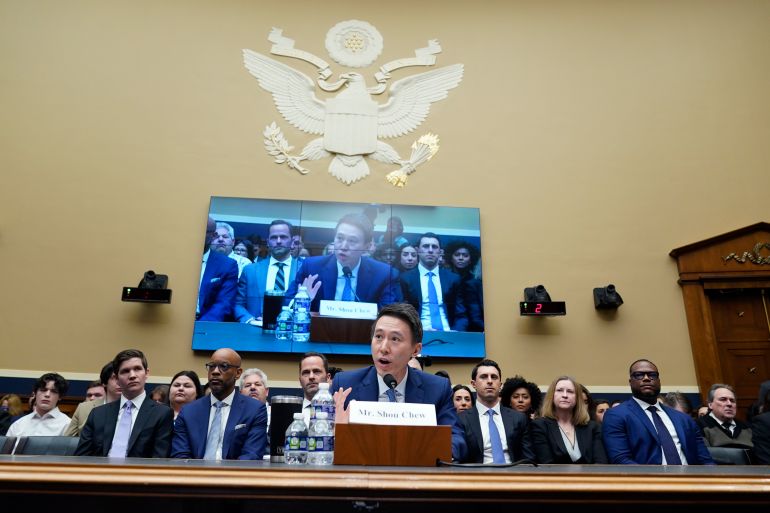
Adam Presser, who was most recently TikTok’s head of operations and trust and safety, will lead the entity as CEO. He will work with a seven-member, majority American board that includes TikTok CEO Shou Zi Chew.

Who owns TikTok US now?
There isn’t one single owner as the company has been created under a joint venture with multiple investors.
ByteDance will retain a 19.9 percent stake in the venture, despite the fact that the 2024 Biden-era law specified that TikTok US cut ties with the company.
Three investor companies each hold a 15 percent stake:
- Silver Lake – A US private equity firm focused on tech investments and with branches in London, Hong Kong and Singapore. It is chaired by Kenneth Hao. Egon Durban, a co-executive, is on the TikTok US board.
- Oracle – The cloud computing company that has been storing TikTok US data since 2022. It is chaired by billionaire Larry Ellison, a longtime ally of Trump.
- MGX – The UAE-owned investment firm specialising in artificial intelligence (AI) technology, which is chaired by the country’s national security adviser, Tahnoun bin Zayed Al Nahyan
There are eight other investors, including:
- Dell Family Office, owned by Michael Dell, founder of Dell Technologies and a Trump ally
- Vastmere Strategic Investments, an affiliate of Susquehanna International Group, founded by Trump ally Jeff Yass
- Alpha Wave, a global investment company
- Revolution, owned by Steve Case, founder of AOL
- Merritt Way, managed and controlled by San Francisco-based investment firm Dragoneer
- Via Nova
- Virgo Li Inc
- NJJ Capital
What has China said about this deal?
China has not commented specifically on the latest announcement.
Liu Pengyu, the spokesperson of the Chinese embassy in Washington, told reporters on Thursday, in advance of the deal becoming public, that “China’s position on TikTok has been consistent and clear”, but did not go further.
However, Trump signalled that Chinese President Xi Jinping was on board with the agreement when he praised his counterpart in his Truth Social statement on Friday.
“I would also like to thank President Xi, of China, for working with us and, ultimately, approving the Deal,” Trump wrote.
“He could have gone the other way, but didn’t, and is appreciated for his decision,” he added.
Trump claim on NATO role in Afghanistan draws UK condemnation

United States President Donald Trump has drawn criticism from British politicians after claiming that NATO forces stayed away from the front line during the war in Afghanistan.
The US president made the remarks in an interview with Fox News, a US broadcaster, where he again questioned the value of the military alliance and suggested that NATO allies would not come to Washington’s aid if requested.
Speaking on Thursday, Trump said the US had “never needed” NATO and claimed allied forces remained “a little off the front lines” during the Afghanistan conflict.
The comments prompted a backlash across the UK political spectrum, with critics pointing to the scale of NATO casualties during the 20-year war and raising questions about Trump’s own military record.
Allies’ losses
The United Kingdom lost 457 service personnel in Afghanistan. More than 150 Canadian soldiers were killed, along with 90 French soldiers. Denmark lost 44 soldiers – one of the highest per-capita death rates among NATO members – despite the country recently facing continued pressure from Trump to sell its semi-autonomous territory of Greenland to the US.
Stephen Kinnock, a junior British minister, described Trump’s remarks as “deeply disappointing” and said European forces had paid a heavy price while backing US-led operations.
“Many, many British soldiers and many soldiers from other European NATO allies gave their lives in support of American-led missions in places like Afghanistan and Iraq,” Kinnock told the UK’s Sky News broadcaster on Friday.
“I think anybody who seeks to criticise what [our armed forces] have done and the sacrifices that they make is plainly wrong,” he added.
‘How dare he’
Kinnock also noted that the US remains the only NATO member to have invoked Article 5, the alliance’s collective-defence clause, following the September 11, 2001 attacks, prompting allies to rally behind Washington.
He said NATO was the most successful international security alliance “in the history of the world”, with the US and its European partners, including the UK, playing a central role.
Other UK politicians highlighted Trump’s history of avoiding military service during the Vietnam War. Trump received multiple draft deferments, including one based on a diagnosis of bone spurs in his heels – a medical claim that has previously been questioned.
“Trump avoided military service 5 times,” Ed Davey, leader of the UK’s Liberal Democrats, wrote on X. “How dare he question their sacrifice.”