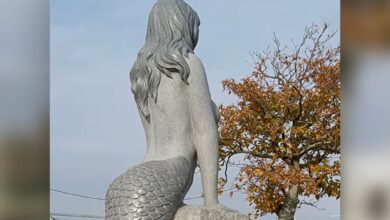
Denmark Orders Removal of Controversial Mermaid Statue Near Copenhagen


The Danish Agency for Culture and Palaces announced the need to dismantle the 4-meter statue of the “Great Mermaid” from Dragør Fort near Copenhagen. The reason for this decision was breaches of heritage protection rules and criticism of the artwork’s execution. The Art Newspaper reports this.
The statue was created as a large-scale version of the famous “Little Mermaid” and was initially installed near the original in central Copenhagen. In 2018 the figure was moved to Dragør Fort, which is a cultural heritage site and is under constant protection under the Danish Museum Act.
After inspection the agency found that the owner placed the statue without the proper permit. The agency stressed that it breaches the fort’s historical fabric and looks like a foreign element on the fort’s grounds.
In recent weeks the work has sparked lively discussions due to the depiction of a nude female body. Cultural critics from the Danish publications Berlingske and Politiken characterized the figure as “pornographic” and “aesthetically unappealing”.
“The proportions of the statue correspond to its scale,”
– Peter Bech, the entrepreneur who commissioned the work
Legal Framework and Future Steps
The agency’s statement emphasizes that the owner did not obtain the necessary permits for placing the artwork on the fortifications, and that the display may violate the requirements for preserving the fort’s historical architecture. In this regard, options for dismantling and accountability for enforcing the decision are being considered.
Dragør Fort is among Denmark’s cultural heritage sites and is protected under heritage protection laws. This means that any placement or relocation of exterior objects without coordination with the relevant authorities may be regarded as a violation of legal norms and lead to demands to restore the object’s status to its previous condition.
Public Response and Cultural Debates
Discussions around the sculpture highlight the line between contemporary art and the preservation of historical heritage. Critics note that the process of addition disrupts the fort’s historical integrity and creates a conflict between artistic expression and preservation requirements. Some experts point to the need for clear permitting procedures and transparent rules for placing such works in public spaces.
Now the authorities and private owners face the question: who will bear ultimate responsibility for dismantling and removing the work from public space if the owner turns out to be a private individual or an organization with a status different from the city or the port?
“The proportions of the statue correspond to its scale,”
– Peter Bech, the entrepreneur who commissioned the work
The Future of Public Art in Denmark
This situation underscores the difficulty of balancing artists’ freedom of expression with the obligation to preserve cultural sites as a public asset. In Denmark, discussions continue about clearer rules for placing contemporary works in public spaces, as well as approaches to interaction between private sponsors and state heritage protection authorities. At the same time, other cities may take note of Denmark’s approach to assessing the alignment of artistic objects with the historical and architectural context of fortification complexes.
It is expected that further decisions regarding the fate of this sculpture will combine legal frameworks, aesthetic assessments, and public opinion to find a balance between artistic intent and preserving cultural heritage for future generations.